SPECIAL INVESTIGATIVE SERIES: THE EHRC AT THE CROSSROADS
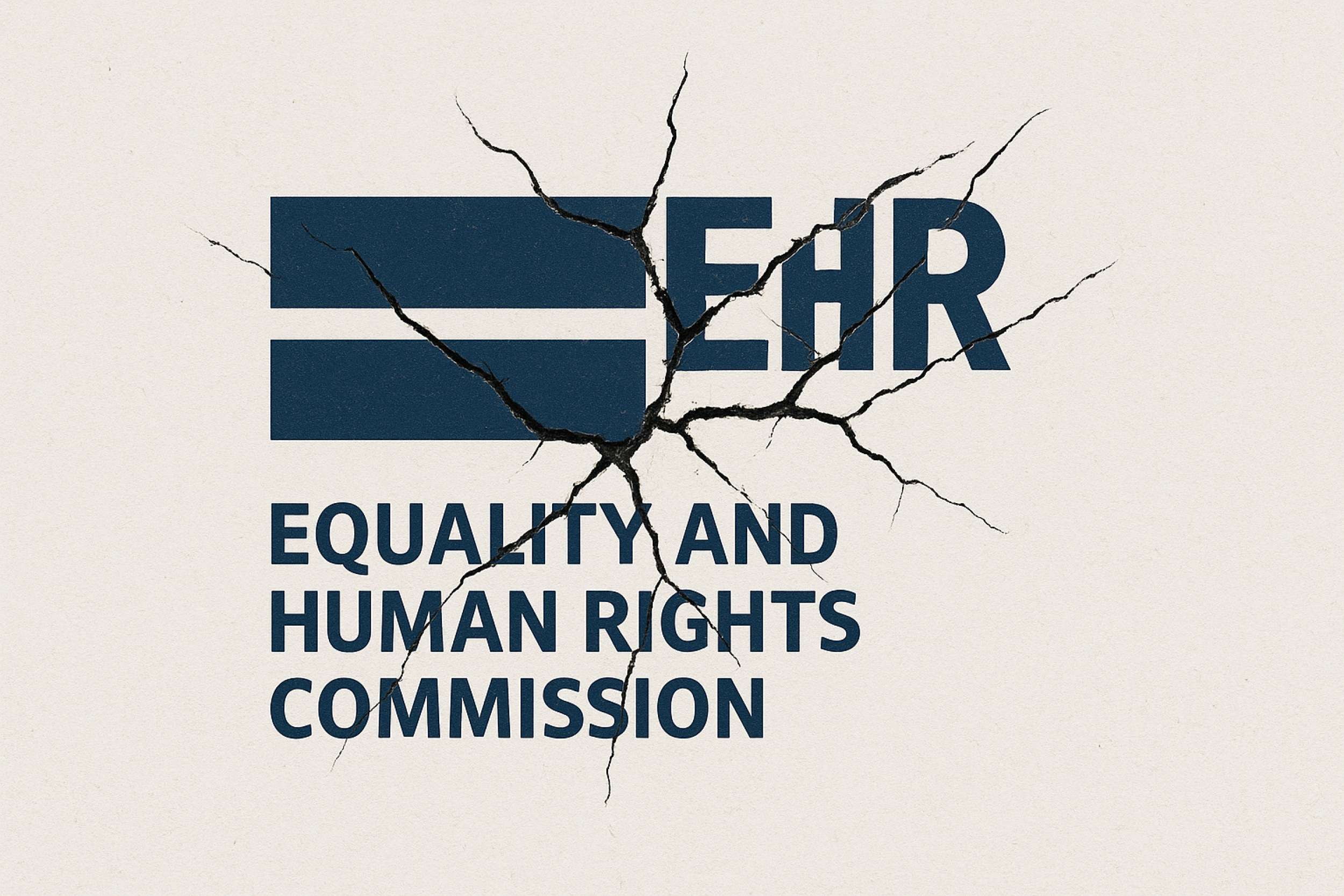
Is Britain's Equality Watchdog Broken?
The Equality and Human Rights Commission was built to protect us. Now, under captured leadership, it's being used as a weapon. This six-part series investigates how it happened, who's driving it, and how our community can build power beyond a broken system.
Author: Tara K Fraser
PART 1: THE HOSTILE TAKEOVER: HOW THE EHRC STOPPED PROTECTING US
Under Kishwer Falkner, Britain’s equality watchdog turned against the very people it was meant to defend. Here’s what happened—and why it matters to every LGBTQ+ person.
The EHRC has shifted from protector to persecutor. We detail the policies that marked its hostile takeover and why this institutional betrayal threatens every LGBTQ+ person in the UK.
If you feel like the Equality and Human Rights Commission (EHRC) has become an opponent, you’re not imagining it. In a staggering reversal, the very body created to uphold our rights has spent the last two years leading the charge to strip them away—specifically from the transgender community. This isn't just bureaucratic drift; it’s a hostile takeover. And its effects ripple out to every one of us.
Let's be clear about what happened. Under its former Chair, Kishwer Falkner, the EHRC:
- Blocked Scottish Gender Recognition Reform: It advised the UK government to veto Scotland’s bill to simplify the process for trans people to get legal recognition—a move praised by human rights bodies across Europe.
- Pushed for Wider Discrimination: It actively promoted rules letting businesses and services more easily exclude trans people from single-sex spaces like bathrooms and shelters.
- Launched the Nuclear Option: Most devastatingly, it advised the government that the term ‘sex’ in the Equality Act 2010 should be legally redefined to mean ‘biological sex.’ This isn't a tweak; it’s a legal erasure. It would remove protections for trans people in healthcare, employment, and public life overnight.
For trans people, this isn't abstract policy. It means fearing for your job, being denied medical care, or being turned away from a domestic violence shelter. The EHRC, your supposed protector, is architecting the framework for that discrimination.
The International Shame
The international community is watching in horror. The Council of Europe—the continent’s leading human rights body—now lists the UK alongside Hungary, Poland, and Russia as a country where "virulent anti-LGBTI discourse" is a major problem. Our global reputation as a progressive leader is in tatters.
Why This Matters to the Entire LGBTQ+ Community
This is not just a ‘trans issue.’ The EHRC is our canary in the coal mine. If the state’s primary equality body can be weaponised against one marginalised group with such precision and political backing, it sets a terrifying precedent. It demonstrates how quickly hard-won rights can be unraveled not by repealing laws, but by reinterpreting them from within. An institution that no longer defends the most vulnerable among us is an institution that has failed everyone.
“The EHRC is no longer our shield. For many in the trans community, it's now the weapon being used against them.”
The takeover is complete. But a new boss has just taken the chair. Is this a chance for a U-turn, or just a new driver for the same dangerous agenda?
PART 2: THE LEGAL BLUEPRINT: HOW A COURT RULING WAS TWISTED INTO A WEAPON
To understand the EHRC's attack, you must understand the 'Binary Sex Principle'—a political invention built on a distorted court case.
How the 'Binary Sex Principle' was manufactured from a narrow legal ruling and is now being used to justify stripping trans people of rights. An explainer on the McConnell and Forthright cases.
The EHRC’s radical advice to redefine "sex" in law didn't come from nowhere. It’s based on a deliberate, bad-faith interpretation of specific judgments, crafted into a weapon. To see the playbook, you must understand two key cases.
Case 1: McConnell – The Narrow Ruling That Was Stretched
The case of R (McConnell) v The Registrar General [2020] concerned a trans man who wanted to be registered as his child’s "father." The High Court ruled that for the narrow, historical purpose of birth registration, the person who gives birth is the "mother."
Crucially, the judge stressed this was a limited ruling about one administrative form. He affirmed that a Gender Recognition Certificate (GRC) makes someone their affirmed sex for the "vast majority of circumstances."
How It Was Distorted
Activists and their legal allies stripped away all context. They took this narrow ruling and proclaimed it established a universal "Binary Sex Principle": that in all matters of law, ‘sex’ means immutable ‘biological sex.’
Case 2: Forthright – The Weaponisation Is Complete
This distortion became real in the 2024 case, R (Doyle) v Secretary of State. Here, the High Court ruled that for the purpose of getting more "women" onto FTSE 350 boards (a "positive action" measure), trans women with a GRC do not count.
This is the legal earthquake. It takes the fabricated "principle" and applies it directly to the Equality Act for the first time, creating a two-tier legal womanhood where trans women are excluded from measures designed to remedy discrimination.
Why This Matters
The Forthright ruling is the judicial validation the EHRC craved. It provides the "precedent" to argue the Equality Act must be rewritten to exclude trans people from legal protections across the board—in shelters, healthcare, and sports. It’s no longer theoretical; it’s a live, successful legal campaign, and the EHRC is its champion in the corridors of power.
PART 3: NEW BOSS, SAME AGENDA? THE INCOMING CHAIR'S TROUBLING RECORD
Dr. Mary-Ann Stephenson isn't a blank slate. Her history suggests she's aligned with the ideology driving the EHRC's attack.
An analysis of new EHRC Chair Dr. Mary-Ann Stephenson's record, including her signing of a controversial letter, and what it signals for the future of UK equality policy.
With the departure of Kishwer Falkner, many in the LGBTQ+ community dared to hope for change at the Equality and Human Rights Commission. Enter Dr. Mary-Ann Stephenson, the new Chair appointed in late 2024. To understand what her leadership means, we must look past the title and examine her record. What we find shatters any illusion of a ‘blank slate’ reformer.
Stephenson is a respected social policy expert and the former director of the Women’s Budget Group. While her work on gendered economic inequality is notable, a key public action reveals her stance on the defining equality battle of our time.
In 2021, she co-signed a letter to The Guardian concerning a London conference. The letter defended the presence of prominent anti-trans campaigners and was framed as a defence of “freedom of speech and assembly for those with gender-critical views.”
This was not a neutral act of free speech advocacy. In the heated UK context, “gender-critical” is the political movement whose core belief denies the validity of transgender identity and positions trans rights as a threat to women’s rights. By publicly signing this letter, Stephenson:
- Legitimised a Hostile Movement: She positioned those who fundamentally deny trans identity as a protected faction in a debate, rather than acknowledging their rhetoric as a source of real-world harm and discrimination.
- Chose a Side: The letter specifically advocated for the protection of “gender-critical” speech in that contested space. It showed a priority for protecting the speech rights of those questioning trans existence over the safety and inclusion of trans people.
- Revealed a Framework: It indicated she views the landscape through the same “conflict of rights” lens that has driven the EHRC’s recent policies—a lens that sees trans inclusion and women’s rights as inherently at odds.
Version 2.0, Not a Reset
This evidence strongly suggests Dr. Stephenson is not a disruptor sent to clean house. She is an ideological successor. Her appointment signals continuity, not change.
Expect the Falkner-era agenda to continue, but the style may shift. The push to redefine ‘sex’ in the Equality Act will likely proceed, argued with more academic polish. The advocacy for sweeping single-sex exemptions will continue, buried in more bureaucratic language. The mission remains the same: to legally narrow the definition of who is protected.
“With Stephenson, the hostility may become more polite, but the goal remains the same: the legal erasure of transgender people.”
The hope for internal reform is extinguished. The new boss is a product of the same ecosystem that broke the watchdog.
PART 4: FOLLOW THE MONEY: THE SHADOW NETWORK BANKROLLING THE BACKLASH
How can a movement with few active members wield such power? The answer lies in a web of dark money and strategic funding.
Investigating the funding behind the UK's anti-trans movement. We trace the money from US Christian right groups to UK lobbying efforts, exposing the network that fuels the "culture war."
The anti-trans movement in the UK presents a powerful, media-savvy front, yet its active membership is relatively small. Its ability to “punch above its weight”—driving litigation, media cycles, and policy change—stems not from grassroots support but from its structure as a professionalised political lobbying network. Its survival and influence are powered by strategic funding, often intentionally obscured.
1. The “Holding Company” Model
Your intuition is correct. The ecosystem functions like a corporate group. Dominant “parent” organisations provide the infrastructure. The most significant is The Christian Institute, a well-funded socially conservative lobby group. It provides legal, administrative, and financial support to a constellation of smaller campaigns, acting as an incubator and fiscal host. It was the primary early funder behind the “LGB Alliance,” providing it with crucial seed money and legitimacy.
2. The Transatlantic Pipeline
- US Christian Right Funds: Organisations like the Alliance Defending Freedom (ADF International)—designated a hate group by the Southern Poverty Law Center—provide direct legal counsel and strategic litigation support in UK courts.
- “Dark Money” Conduits: US-based philanthropic vehicles like Donors Trust and Donors Capital Fund (often called the “dark money ATM” of the American right) channel anonymous millions from wealthy conservatives to groups worldwide, including those in the UK promoting “family values” and opposing transgender rights.
3. The “Multiple Hats” Strategy & Core Network
The movement relies on a tight-knit cadre of activists, lawyers, and media figures who rotate through key roles, creating a closed loop.
- Interlocking Directorates: The same individuals appear as directors, trustees, and spokespeople for multiple groups (e.g., Sex Matters, LGB Alliance, Fair Play For Women).
- Symbiosis with Media: Columnists from major newspapers often serve as de facto spokespeople, platforming the network’s arguments, while its members provide a steady stream of “expert” commentary.
4. Alignment with Broader Political Projects
Crucially, the movement doesn’t need to fund everything itself. Its goals align perfectly with the strategic interests of larger, well-resourced players:
- The “Culture War” Wing of the Conservative Party: The movement provides the ideological justification for policies that energise a segment of the base. In return, it gets political access and the ultimate prize: state power via institutions like the EHRC.
- “Anti-Woke” Funders: Billionaires and foundations opposing “ESG” (Environmental, Social, and Governance) investing and so-called “woke capitalism” see anti-trans campaigning as a useful wedge issue to attack the framework of progressive human rights itself.
The Public as Pawns
This explains the potency. It is a spearhead of a much larger, well-resourced ideological project. The public, donating to emotive crowdfunders or reacting to media storms, are often the pawns—the source of funds and political cover—in a game orchestrated from above.
PART 5: A GLOBAL WAR: HOW THE UK FITS INTO AN INTERNATIONAL ASSAULT ON RIGHTS
The fight here is one front in a coordinated, worldwide campaign. The UK is both a laboratory and an exporter of anti-LGBTQ+ tactics.
The UK's anti-trans movement is part of a global network. We connect the dots between UK funders, US Christian right groups, Eastern European governments, and African anti-LGBTQ+ laws.
The battle over trans rights in the UK is not an isolated domestic “culture war.” It is a critical front in a well-funded, internationally coordinated movement to roll back gender and sexual diversity worldwide. The tactics, funding, and rhetoric flow seamlessly between the UK, the US, Eastern Europe, Africa, and beyond.
The UK as a “Proof of Concept” and Expertise Hub
The UK’s sophisticated legal system and influential media make it a prized laboratory.
- Legal Precedents for Export: A UK High Court ruling like the Forthright case is immediately cited in legal briefs in the US, Europe, and Commonwealth nations as persuasive evidence from a “mature jurisdiction.”
- Talent Export: Key UK-based activists and academics are flown to testify before US state legislatures and African conferences, presenting the UK’s “debate” as a cautionary tale of “gender ideology.”
The Common Funding & Ideological Pipeline
The money and ideas have no borders. Major US Christian Right funders operate a tri-continental strategy:
- They fund groups in the UK to create legal and media content.
- They fund networks in Eastern Europe (e.g., Ordo Iuris in Poland) to push “family sovereignty” laws.
- They directly train lawmakers and religious leaders in Africa to promote extreme anti-LGBTQ+ legislation, like Uganda’s Anti-Homosexuality Act.
Exploiting Local Contexts (Different Tactics, Same Goal):
- In Eastern Europe: The rhetoric is civilisational, nationalist, and anti-EU. LGBTQ+ rights are painted as “Western decadence” threatening the traditional, Christian nation.
- In Africa: The rhetoric is anti-colonial and religious. Western-funded evangelists frame LGBTQ+ identities as a “white man’s disease” and a threat to African values—a cruel irony, as the model laws are often written by US evangelicals.
- The “Gender Ideology” Framing: This term, now global, was weaponised to bundle transgender rights, sex education, and feminism into a single, foreign “colonial” threat.
The UK’s Specific Role: The “Respectable Face”
The UK provides something the US Christian Right or an autocratic regime cannot: the appearance of reasoned, democratic debate in a respected liberal democracy. When a Ugandan politician defends a draconian law, they can point to the EHRC’s legal advice or a UK court ruling and say: “Even in enlightened Britain, they see the dangers.”
Conclusion: A Transnational Assault
Our struggle in the UK is one front in a global war. A defeat here weakens defenders of equality in Poland and empowers persecutors in Ghana. Conversely, a victory in a UK court becomes a tool for activists everywhere. The opponents are deeply connected; we must be too.
PART 6: BUILDING OUR OWN SANCTUARY: A COMMUNITY BLUEPRINT FOR POWER
The institutions have failed. Our path forward is to build unshakeable, community-powered resilience. Here’s how.
A practical, empowering guide for the LGBTQ+ community. From mutual aid and legal strategy to international pressure, here’s how to build power when the official watchdog is against you.
The EHRC saga delivers a brutal but clarifying lesson: we cannot outsource our safety to institutions that can be captured and turned against us. The state’s equality machinery is in hostile hands. Our response must be a strategic pivot to community-powered resilience. Here is a multi-pronged blueprint for action.
1. Fortify Direct Support & Mutual Aid (The Front Line)
When systems fail, we become the system.
- Expand Trans-Led Crisis Funds: Bolster funds for healthcare costs, legal fees, relocation, and basic living costs for those most targeted.
- Create & Map Safe Havens: Develop verified networks of trans-friendly GPs, therapists, lawyers, and shelters. Make this intelligence community-owned.
- Scale Up ‘Community Defence’ Training: Organise workshops on digital security, knowing your rights, and mental health first aid.
2. Master the Legal & Political Game (The Counter-Attack)
We must strategically use the remaining democratic tools.
- The GANHRI Project – Our Biggest Lever: The EHRC’s international ‘A-status’ accreditation is its soft underbelly. It was deferred in 2022 due to concerns over its actions on trans rights. We must make its downgrade a community-wide mission. Supporting NGOs to submit damning evidence to the Global Alliance of National Human Rights Institutions (GANHRI) could strip the EHRC of its UN voting rights and global credibility. This is our most powerful form of institutional accountability.
- Hyper-Local Political Power: Shift focus. Run for local council, school boards, and police oversight panels. Lobby Metro Mayors. Protect inclusive policies where we live.
3. Build Narrative Sovereignty (The Information War)
We cannot let our story be told by our opponents.
- Flood the Zone with Truth: Create and share content that humanises, educates, and celebrates. Support trans journalists, artists, and creators.
- Form Alliances of the Willing: Build bridges with inclusive unions, racial justice organisations, and disability rights groups. Isolate our opponents by showing their ideology is a minority view among those fighting for justice.
4. The Long Game: Vision & Unapologetic Joy
- Develop a Shadow ‘Equality Charter’: Draft model legislation for a future, truly protective equality body. Be ready when the political weather changes.
- Invest in the Next Generation: Create mentorship and scholarships for LGBTQ+ youth in law, politics, and media. We need our people inside every profession.
- Practice Radical Joy: Our resistance is not just in battle; it is in our thriving. Celebrate our love and our lives loudly. Our joy is an act of defiance and a renewable energy source.
Who’s Watching the Watchdog? The Accountability Deficit
The formal checks have failed. Parliamentary oversight is compromised. The EHRC board is not a check. True accountability now lies with us in three arenas:
- International Shaming (via GANHRI and bodies like the Council of Europe).
- Strategic Litigation in the courts.
- The Ballot Box, to change the government that appoints the EHRC’s leaders.
“Our power was never truly vested in stone buildings in Westminster. It has always resided in our connections, our courage, and our unwavering commitment to each other.”
The EHRC’s betrayal is not an endpoint. It is a brutal catalyst. It forces us to stop looking upward for permission and protection, and to look inward and sideways—to our own ingenuity and profound strength. The way forward is not through the doors of an institution that locked us out. It is on the path we build ourselves, brick by brick, case by case, heart by heart.
Let’s get to work.
2. KEY SOURCES:
- EHRC advice on Scottish GRR
- Council of Europe report naming UK
- The Guardian letter (2021)
- McConnell judgment
- Forthright (Doyle) judgment
- OpenDemocracy investigation into funding
- GANHRI Sub-Committee on Accreditation page