Universities across the UK are increasingly drawn into national debates about gender identity, academic freedom, and the rights of trans staff and students. These institutions are not ideological actors; they are employers, educators, and public bodies with overlapping legal duties. Yet they often find themselves portrayed as villains or heroes in a culture war that thrives on oversimplification.
Two recent cases at the University of Bristol — the Raquel Rosario Sánchez dispute and the suspension of Professor David Gordon — illustrate how universities are pulled into conflicts they did not initiate and cannot easily control. They also show how media outlets, particularly The Telegraph, shape public perception in ways that intensify pressure on institutions already trying to balance competing obligations.
Legal and Institutional Landscape
Universities must simultaneously uphold the Equality Act 2010, academic freedom duties, freedom of speech duties, safeguarding responsibilities, internal governance rules, and reputational obligations as employers and public institutions. None of these duties cancels the others. They overlap, sometimes uncomfortably, and universities must navigate them case by case. This is the tightrope.
Case 1: Raquel Rosario Sánchez
Raquel Rosario Sánchez, a Dominican PhD student, alleged that the University failed to protect her from harassment after she chaired a meeting of Woman’s Place UK, a gender‑critical organisation. She argued that the University did not intervene effectively when she reported bullying by other students.
The University maintained that it followed proper procedures and did not take a position on the underlying ideological dispute. The case became a national symbol in gender‑critical media spaces, often framed as evidence that universities were hostile to women’s rights. Internally, however, the University treated it as a procedural safeguarding and conduct issue, not an ideological one.
Case 2: Professor David Gordon
Professor Gordon was suspended after replying to an email from the University’s LGBTQ+ Staff Network in which he defended his invitation to a gender‑critical academic. The University accused him of breaking rules by responding in that context.
Again, the University did not publicly take a stance on gender‑critical ideology. It framed the matter as a contractual and procedural issue about communication channels, representation, and internal governance, not about the belief itself.
This distinction matters. Holding gender‑critical beliefs is protected. Expressing them in a personal capacity is protected. Using institutional channels or authority in ways that breach internal rules is a conduct issue, not a belief issue. But this nuance rarely survives contact with the media.
Media Framing
The national press, and The Telegraph in particular, plays a significant role in shaping how these disputes are understood. Its coverage often frames universities as ideologically biased, emphasises conflict, personalises disputes around individual academics, positions gender‑critical individuals as embattled truth‑tellers, and encourages public scrutiny of internal university processes.
This framing simplifies complex institutional dynamics into a story of free speech under attack. It also creates a feedback loop: a procedural matter occurs; a gender‑critical outlet reframes it as ideological suppression; the story is amplified; universities face pressure to respond publicly even when confidentiality rules prevent them from doing so; and silence is interpreted as guilt or bias. This cycle makes it almost impossible for universities to manage disputes quietly or proportionately.
The Freedom of Speech Act
The Higher Education (Freedom of Speech) Act 2023 was introduced to strengthen protections for lawful speech on campus. It requires universities to take reasonably practicable steps to secure freedom of speech, protect academic freedom, avoid no‑platforming, create a new complaints scheme via the Office for Students, and appoint a Free Speech Champion.
On paper, the Act provides clarity. In practice, it adds another layer of legal obligation to an already crowded field. It does not override safeguarding duties, anti‑harassment duties, equality duties, internal governance rules, or employment contracts. Universities must now balance even more duties, some of which can pull in opposite directions.
The Act does not protect staff who imply they speak for the university when they do not, use institutional channels inappropriately, breach codes of conduct, or violate confidentiality or HR processes. Many disputes arise not from the belief itself but from the context in which it is expressed.
Why Universities Look Inconsistent
From the outside, it can appear that universities treat gender‑critical and trans‑inclusive concerns differently. But the underlying pattern is usually consistent.
- When trans staff or students raise concerns, universities respond through formal EDI structures, which are embedded and resourced.
- When gender‑critical staff raise concerns, universities respond through case‑specific investigations, which are necessarily confidential and procedural.
- When staff use institutional channels to express personal beliefs, universities intervene because representation, not ideology, is at stake.
- When media outlets amplify disputes, universities are forced into defensive postures, often unable to correct the public narrative because of legal constraints.
The result is a perception of bias, even when the institution is following the same logic in every case.
The Real Story
Universities are not trying to suppress gender‑critical beliefs, nor are they trying to undermine trans rights. They are trying to protect staff and students, uphold multiple legal duties, maintain internal governance, avoid litigation, and keep functioning in a hostile media environment. They are walking a tightrope while being pushed from both sides. And when newspapers like The Telegraph turn internal disputes into national flashpoints, universities become targets in a conflict they did not choose.
Conclusion for LGBTQ+ Communities and Allies
For LGBTQ+ people and allies, these university disputes can feel exhausting. They are framed as abstract debates about free speech or ideology, but the impact lands on real people trying to learn, work, and feel safe.
It is important to remember that universities are not monoliths. They are complex ecosystems full of people who care deeply about inclusion, fairness, and the wellbeing of their communities. Even when institutions appear slow or inconsistent, most of the individuals inside them are trying to do the right thing under enormous pressure.
LGBTQ+ communities and allies can navigate this landscape by staying connected to each other rather than to the noise, understanding the difference between belief and conduct, supporting the people doing the quiet work, holding institutions accountable without assuming malice, recognising when media framing is the real problem, and continuing to advocate for trans‑inclusive structures.
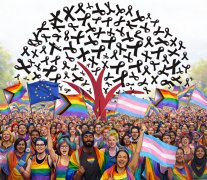
Across the UK, LGBTQ+ communities, allies, unions, and student groups are working together to protect dignity, safety, and inclusion. The landscape is difficult, but the solidarity is real.
Universities are walking a tightrope. LGBTQ+ people are walking it with them, often with more at stake. But we are not powerless, and we are not isolated. By staying connected, informed, and compassionate, we can navigate this moment without losing sight of who we are or what we stand for. Inclusion is not a culture‑war position. It is a commitment to human dignity.